New to leatherworking?
Use a stitching chisel
Stitching chisels are easier to learn and let you focus on the stitching itself.


Stitching chisels and pricking irons both help create evenly spaced hand stitches in leather, but they traditionally do different jobs.
A stitching chisel is designed to punch stitching holes completely through the leather. A traditional pricking iron marks the location and angle of each stitch, after which the holes are opened with an awl.
For most beginners and general leathercraft, stitching chisels are the easier and more practical choice. Pricking irons are better suited to leatherworkers who want greater control over each stitch and prefer a traditional saddle-stitching technique.
There is one important wrinkle: many modern French-style irons are sharp enough to punch through thinner leather, so the line between pricking irons and stitching chisels is not always as clear as it once was.

Swipe sideways to compare →
| Feature | Stitching Chisels Punch Holes | Pricking Irons Mark Stitch Placement |
|---|---|---|
| Primary Purpose | Punch stitching holes | Traditionally mark stitch placement |
| Punch Through Leather? | Yes | Traditionally no, though some modern irons can |
| Awl Required? | Usually no | Usually yes with traditional irons |
| Learning Curve | Easier | More technique required |
| Speed | Faster | Slower |
| Control | Consistent, pre-punched holes | Greater control over individual holes |
| Best For | Beginners, generally leathercraft, production work | Fine leatherwork and traditional saddle stitching |
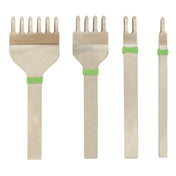
A stitching chisel is a multi-pronged tool used to punch evenly spaced stitching holes through one or more layers of leather.
After marking your stitch line, you place the chisel along the line and strike it with a mallet. The teeth pass through the leather, creating holes that are ready for stitching.
Because the holes are made ahead of time, stitching chisels make it easier to maintain consistent spacing and stitch placement. They are especially useful for beginners because you do not need to open each hole individually with an awl while sewing.
Stitching chisels come in different tooth shapes and spacing options. Diamond, flat, and French-style teeth can each produce a different-looking stitch line, so the tool you choose affects both how you work and how the finished stitching looks.

A traditional pricking iron is used to mark where stitches should go rather than to punch full holes through the leather.
The teeth leave evenly spaced impressions along the stitch line. As you saddle stitch, you then use an awl to open each hole through the leather.
This technique takes more practice because the leatherworker controls the angle and path of every awl hole. That extra step can also make stitching slower, particularly when you are first learning.
The benefit is control. An experienced leatherworker can use a pricking iron and awl to create very clean, refined stitching while minimizing the size of the holes left in the leather.
This is where the terminology becomes less straightforward.
Some modern tools sold as pricking irons, particularly French-style irons, have thin, sharp teeth that can punch completely through thinner leather. In practice, these tools may be used much like stitching chisels.
That means the name printed on the package does not always tell you exactly how the tool should be used.
When choosing an iron or chisel, pay attention to:
Whether the manufacturer intends the tool to mark the leather or punch through it
A traditional pricking iron and a modern French-style iron may look similar, but they may be designed for different techniques.
This is the biggest traditional difference.
A stitching chisel creates the entire hole before you begin stitching. A pricking iron establishes the spacing and angle, but an awl creates the hole during stitching.
That makes stitching chisels simpler and faster, while the pricking iron-and-awl method gives you more control over each individual hole.

Stitching chisels are generally easier for beginners.
Once the holes have been punched, you can concentrate on maintaining consistent thread tension and saddle-stitch technique.
With a traditional pricking iron, you also need to learn how to guide an awl through the leather at a consistent angle without damaging the stitch line or creating uneven holes on the back side.
For most projects, stitching chisels are faster.
You can punch a series of holes at once and then stitch through them. Using a pricking iron and awl adds another step to the process because each hole must be opened as you work.
For production work or projects with long stitch lines, that difference can add up quickly.
Both tools can produce excellent-looking saddle stitches.
The finished appearance depends on more than whether you use a chisel or pricking iron. Tooth shape, stitch spacing, thread diameter, leather thickness, stitch tension, and technique all play a role.
Traditional pricking irons are often associated with fine leather goods because they can create narrow, angled stitch placement without permanently removing much material from the leather.
Modern stitching chisels, however, are available in increasingly fine tooth profiles and can also produce very clean, refined stitching.

Leather thickness can influence which tool is easiest to use.
Stitching chisels work especially well when their teeth can pass cleanly through the entire project. On very thick leather or multiple heavy layers, long chisel teeth can become difficult to remove and may distort the holes.
A pricking iron and awl can give you greater control when working through thicker assemblies because the awl opens each hole individually.
For thinner goods such as wallets, card holders, and small bags, both modern chisels and sharp French-style irons can work very well.

For most beginners, stitching chisels are the better place to start.
They make it easier to create evenly spaced holes and let you focus on learning the saddle stitch itself rather than trying to master an awl at the same time.
Stitching chisels are also a practical choice for experienced leatherworkers who value speed and consistency.
Traditional pricking irons are worth considering if you want to learn classic saddle-stitching technique, regularly work on fine leather goods, or want more control over exactly how each stitching hole passes through the leather.
Modern French-style irons can offer something in between. They provide the narrow, angled tooth profile associated with fine hand stitching while still allowing you to punch through thinner leather before sewing.
Ultimately, neither tool is automatically better. The best choice depends on the leather you are using, the look you want, and how you prefer to work.

Swipe to find the right tool for you →
Use a stitching chisel
Stitching chisels are easier to learn and let you focus on the stitching itself.
Use a stitching chisel
Punch multiple holes at once for a consistent stitch line and faster workflow.
Use a pricking iron + awl
Pricking irons mark the stitch line and give you greater control over each hole when used with an awl.
Use a modern French-style iron
Many modern French-style irons have sharp, narrow teeth that can punch through thinner leather, giving you a clean, refined stitch line.
Consider a pricking iron + awl
An awl gives you more control when working through thick leather or multiple layers.
Stitching chisels are generally easier for beginners because they create the stitching holes before you begin sewing. That removes the need to handle an awl while learning saddle-stitch technique.
Usually not. If your stitching chisel punches completely through all layers of leather, you can stitch directly through the holes. An awl can still be useful for reopening tight holes or working through areas that are difficult to punch.
Traditional pricking irons require an awl because they are designed to mark the stitch placement rather than create a complete hole. Some modern French-style irons can punch through thinner leather, so an awl may not always be necessary.
It depends on the tool. Traditional pricking irons are intended primarily for marking stitch placement, while some modern irons are sharpened specifically so they can punch through leather. Follow the manufacturer’s recommendations rather than assuming every pricking iron should be used the same way.
Yes. Stitch spacing affects both the appearance and strength of the finished stitch line. Finer spacing is often used on wallets and other small leather goods, while larger projects and heavier leather may look better with wider spacing and thicker thread.